
A Travel‑Oriented Look at a Country That Lives with Water, Not Against It
WATER WISDOM SERIES
- Water Wisdom
- Your Dream Trip Along the Tulip Trail
- Haarlem in a Day
- How the Dutch Think About Water
I. A Country Built on Water
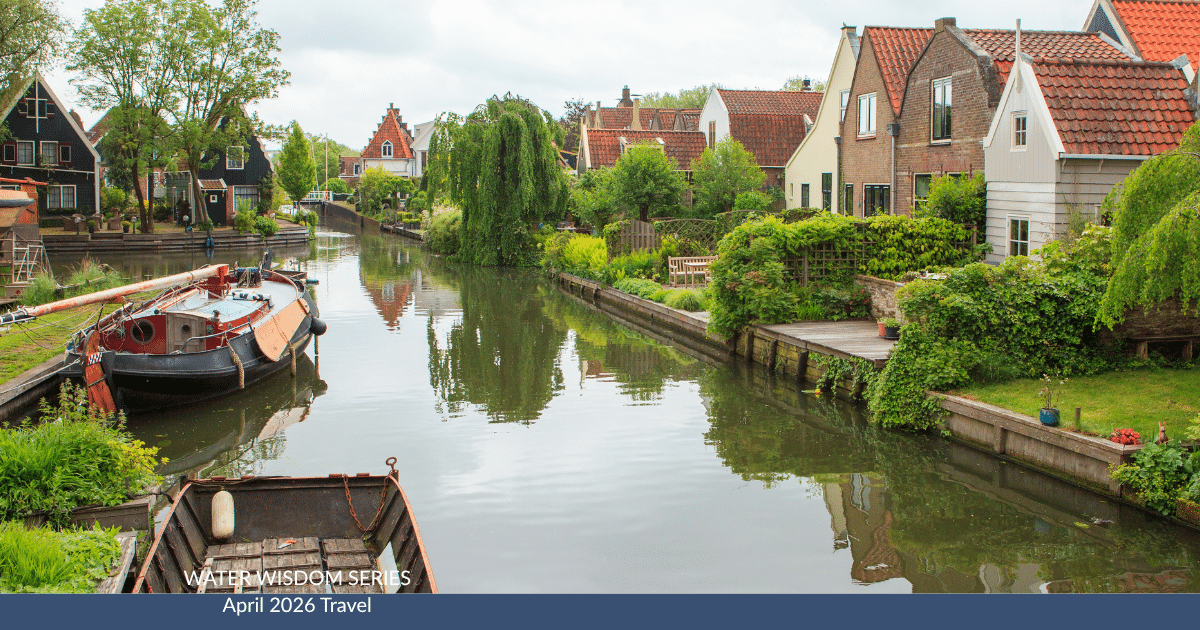
It looks peaceful — but this landscape is the result of centuries of planning, negotiation, and engineering. This is the Dutch water mindset.
The Netherlands is a place shaped as much by water as by land. More than a quarter of the country sits below sea level, and nearly every city, village, and field exists because generations of Dutch citizens learned how to guide water rather than fear it. Travelers feel this immediately — in the canals, in the wide skies, in the calm confidence of a country that has spent centuries negotiating with the sea. When your plane starts its landing procedure, and you look out your window; you see it all. Water everywhere, shoreline, the bay area with its islands around Amsterdam and those long, straight canals. To visit the Netherlands is to step into a landscape where water isn’t a threat or an inconvenience. It’s a partner.
Some Wet Examples

To visit the Netherlands is to step into a landscape where water isn’t a threat or an inconvenience. It’s a partner — a material the Dutch have shaped, managed, and lived with for centuries.
The Dutch must have all read Mark Twain before they dug the canals. “Water taken in moderation cannot harm anyone”.
And yet the Dutch relationship with water isn’t all calm canals and green polders. Beyond the quiet inland fields lies the North Sea — a force that has taken land, lives, and entire villages. This is the water the Dutch fear and respect.

Storm surges have slammed into this coastline for centuries, but the 1953 flood changed everything. More than 1,800 people died, entire towns vanished, and the country realized that guiding water was no longer enough — they had to defend themselves from it.
In the years that followed, the Dutch responded with one of the most ambitious water‑management systems in the world. The Delta Works wasn’t just a project. It was a national vow that the sea would never take this land again.

Today, these structures protect the reclaimed fields that feed the country — including the flat, green pastures where the grass grows that becomes the great Dutch cheeses. The Dutch don’t just live with water; they negotiate with it, shape it, and build a life on land they refused to surrender.
A shift happens once you’ve seen both sides of Dutch water — the calm inland fields and the fierce North Sea.
II. The Dutch Attitude Toward Water
After you’ve seen the calm polders, the dark North Sea, and the massive Delta Works, the Dutch attitude toward water starts to make perfect sense. Ask a Dutch person about water and you won’t get drama or dread — you’ll get practicality. Water comes too high, too fast, too often, and the Dutch respond with design, cooperation, and a steady willingness to adapt. Their entire culture reflects this mindset: don’t fight the water, guide it. Don’t panic, plan. Don’t wait for disaster, build for the future.
And yet, even with all this engineering, many visitors arrive with a different set of images in mind.
A Playful Note About the Clichés We Bring with Us
Many Americans arrive with a few charming clichés in their suitcase — people skating along frozen canals, tidy villages reflected in still water, and of course the little Dutch boy who saves the day with a finger in the dike. The skating has truth to it when winters cooperate, the dike story, not so much. But both images capture something real: our sense that the Dutch have always lived close to water and somehow manage it with calm, everyday heroism. What you discover when you visit is that the real story is even better — not dramatic rescues, but centuries of clever design and steady attention.
Once you understand the mindset, it becomes easy to spot water thinking everywhere you go.
III. Where Travelers Can See Water Thinking in Daily Life
Amsterdam’s Canal Belt: Beauty Built on Engineering
Amsterdam is often love at first sight, especially along the canals — but most visitors don’t realize those waterways were engineered long before they were romantic. The 17th‑century Canal Belt wasn’t designed for postcards; it was a water‑management system first, built to control flooding, move goods, and keep a growing city livable. Today, travelers see elegant bridges, houseboats, and tree‑lined reflections, yet beneath the charm is a centuries‑old design that still works. Walking or boating through the canals is one of the easiest ways to understand the Dutch mindset: water isn’t scenery, it’s structure.

Utrecht’s Wharf Cellars: A Two‑Level Canal You Can Walk Into
Travel a little farther inland and the Dutch relationship with water takes on a different shape. Utrecht offers something you won’t find anywhere else in the world — canals with sidewalks below street level. The wharf cellars along the Oudegracht were built to manage water and trade at the same time, giving merchants direct access to boats while keeping the streets dry above. Today, those old cellars have become cafés, studios, and wine bars right at the water’s edge. Sit with a coffee, watch boats glide by at eye level, and you can feel how naturally the Dutch weave water into daily life.
Rotterdam’s Floating Pavilion: A City Preparing for the Future
Head west toward the coast and the story shifts again — this time toward innovation. Rotterdam, always forward‑looking, has turned its harbor into a testing ground for climate‑resilient design. The Floating Pavilion — three giant, bubble‑like domes — rises and falls with the tide, proving that entire neighborhoods could someday float. Visitors can walk inside, explore exhibitions, and look out over the water to see a city that refuses to be intimidated by its geography. Rotterdam doesn’t just manage water; it experiments with it.

Rotterdam’s Water Squares: Playgrounds When Dry, Lakes When Wet
A short walk away, the city’s creativity shows up in a more playful form. The Benthemplein Water Square transforms depending on the weather: on dry days, it’s a basketball court, skate area, and gathering space; after heavy rain, it becomes a temporary lake, holding stormwater until the system can absorb it. Kids play around the edges, people take photos, and the whole thing feels more like a feature than a compromise. It’s Dutch practicality wrapped in urban fun — and another reminder that water can be a partner, not a problem.
Leave the city behind and the landscape opens into the classic Dutch water story.
Kinderdijk: The Classic Dutch Water Story, Still Working Today
Leave the city behind and the landscape opens into the classic Dutch water story. Kinderdijk’s nineteen historic windmills stand in a long, quiet row, built to pump water out of the lowlands and keep the polders dry. It’s a UNESCO World Heritage site, but it’s also a working system, still doing the job it was designed for centuries ago. Visitors can bike or walk the paths, tour a mill, and see how the Dutch managed water long before modern engineering arrived. It’s beautiful, yes — but it’s also a reminder that this relationship with water is deep, lived, and ongoing.

Maeslantkering: The Giant Gate That Protects a Nation
And then, just when you think you’ve seen the full range of Dutch ingenuity, the scale expands again. For travelers who love big engineering, the Maeslant Storm Surge Barrier is unforgettable. Each gate is the size of the Eiffel Tower laid on its side, and together they protect Rotterdam — Europe’s largest port — from North Sea storms. When the gates close, they swing across the water like two enormous arms. Visitors can tour the site, watch simulations, and feel the magnitude of a country that takes water seriously enough to build moving structures the size of skyscrapers.
After seeing water shaped at every scale — from canals to storm‑surge gates — the design philosophy behind Dutch landscapes becomes clearer.
IV. Water as a Design Partner: The Dutch Wave
After seeing how Dutch cities shape water, it becomes easier to understand how Dutch designers think about landscapes. Piet Oudolf is the best‑known voice of the Dutch Wave, a movement that treats plants as living structures rather than decorations. His work grows out of the Dutch habit of paying attention — to water, to seasonality, to change — and he designs gardens that move, shift, and evolve.
Instead of chasing perfection, Oudolf builds plant communities that can handle extremes, recover from stress, and look beautiful in every season. His gardens aren’t static compositions; they’re systems that respond to weather, light, and time. It’s a philosophy shaped by a country that has always lived with water, not against it — a landscape that teaches resilience by example.
V. A Familiar Example: The High Line in New York
If you’ve walked the High Line in New York, you’ve already seen this philosophy translated into an American skyline. Piet Oudolf designed the planting for the elevated park more than fifteen years ago, and it has proven itself through storms, heat waves, and millions of visitors. The grasses and perennials move with the wind, soften the hard edges of the city, and shift through the seasons in a way that feels both wild and intentional.
Walking the High Line at twilight — when the lights rise and the plantings glow — you can feel how the design holds up under pressure. It’s a living example of how resilience and beauty can coexist, and how a Dutch idea about working with nature can thrive far from the lowlands. The High Line doesn’t imitate the Netherlands; it carries forward the same mindset: build landscapes that adapt, endure, and stay alive to change.

VI. Three Dutch Gardens That Bring This Philosophy to Life
After seeing how Dutch designers work with water in cities, it becomes even more interesting to look at how this mindset appears in gardens. Across the Netherlands, you’ll find landscapes shaped not just for beauty, but for resilience — places where planting, soil, and water work together rather than compete.
These three gardens show what that philosophy looks like on the ground. Each one responds to water in a different way, from slowing urban runoff to thriving without irrigation. Together, they form a quiet, powerful lesson in how design can adapt to a changing climate.
Introduction to Three Water‑Wise Dutch Gardens
Dutch and water have been linked for centuries, shaping how people build, plan, and think about daily life. The country’s long history of managing water has created a practical, steady mindset that influences everything from neighborhoods to national policy.
As climate change brings heavier rains and longer droughts, even the Dutch are rethinking how gardens handle water. Three gardens across the country show what that shift looks like in practice, each offering a different response to the same challenge.
Vlinderhof, Utrecht — A Community Garden Built on Movement and Resilience
In Utrecht, Vlinderhof — Piet Oudolf’s free, volunteer‑run public garden — uses deep‑rooted perennials and grasses to slow urban runoff and hold moisture in the soil. The planting is designed to move with weather and season, creating a resilient landscape that thrives without fuss.

Bloemenpark Appeltern, Gelderland — The Ongoing Experiment
Farther east in Gelderland, Bloemenpark Appeltern showcases more than 200 model gardens built around het nieuwe tuinieren, the Dutch movement encouraging homeowners to replace pavement with plants. Stormwater capture becomes a design feature, proving that even small gardens can make a measurable difference.
Lianne’s Siergrassen, Friesland — A Garden That Lives on Water Discipline
Near the Friesland border, Lianne’s Siergrassen takes the idea further still. Its prairie and steppe gardens run on zero irrigation and zero fertilizer, relying on deep‑rooted grasses to build a self‑sustaining water cycle that can handle both flood and drought. It’s a living demonstration of what low‑input, climate‑resilient gardening looks like in northern Europe.
Travelers don’t need to memorize engineering terms or understand the mechanics of a storm‑surge barrier. What stays with you is the mindset: the calm, practical way the Dutch meet water where it is. You start to notice how they design for change, not perfection. How they build landscapes that move, cities that adapt, and public spaces that welcome water instead of fearing it. It’s a way of thinking that lingers long after the trip ends.
VIII. Conclusion: The Mark Twain Contrast
Mark Twain once wrote, “Water, taken in moderation, cannot hurt anybody.” The Dutch would agree — they’ve just spent a few centuries figuring out exactly what moderation means when your entire country sits below sea level. What Vlinderhof, Appeltern, and Lianne’s Siergrassen prove is that the answer isn’t concrete walls and bigger pumps — it’s roots, rhythm, and letting plants do what they already know how to do. Whether you visit for the design inspiration, the sheer beauty, or just to see what a garden looks like when it stops fighting the weather and starts working with it, these three stops will change the way you think about your own patch of ground. We’ll have more to say about that — but for now, pack comfortable shoes, bring a notebook, and let the Dutch show you what happens when a garden learns to drink responsibly.
Up Next: May’s Theme — Small Gardens — Big Impact
Next up is May, and with it a new theme: Small Gardens — Big Impact. This 4‑week series explores the power of compact spaces — how thoughtful planting, smart structure, and a few well‑chosen ideas can transform even the smallest garden into something meaningful. After a month spent with Dutch water thinking, we shift the focus closer to home: the intimate spaces where design meets daily life and small choices create big change.
Questions and Answers
Answer One third of the country lies below sea level, so centuries of engineering and cooperation shaped daily life.
Answer A polder is reclaimed land protected by dikes and pumps, and it defines much of the Dutch landscape.
Answer Yes. Places like the Delta Works, Afsluitdijk, and Kinderdijk offer tours and visitor centers.
Answer Through adaptive engineering, flexible floodplains, and long term national planning.
Answer Manage water at the source by improving drainage, capturing rainwater, and designing landscapes that work with water rather than against it.
Happy Digging,
Jane
Photo Attributions
Part of the Delta Works Wikimedia Commons
Vindenhorf Garden
Appletern Garden
Kinderdijk Windmills Dmytro Balkhovitin, CC BY-SA 4.0 httpscreativecommons.orglicensesby-sa4.0, via Wikimedia Commons
Articles
How the Netherlands Feeds the World, National Geographic
Books
- Planting: A New Perspective — Piet Oudolf & Noel Kingsbury A foundational book on naturalistic planting design and how structure, seasonality, and movement shape resilient gardens.
- Designing with Plants — Piet Oudolf & Noel Kingsbury A deeper dive into plant form, texture, and how to build plant communities that thrive with minimal inputs.
- The Dutch and Their Delta — Jacob Vossestein A readable introduction to how the Netherlands manages water at every scale — engineering, culture, and daily life.
Video
- DW Documentary: “The Dutch and the Water” A short, accessible documentary explaining how the Netherlands designs with water, featuring Delta Works, Room for the River, and urban water innovations.
📌 How the Dutch Think About Water
📌 Why Water Shapes Dutch Life
📌 Dutch Water Design in Action
📌 Water Places to See in the Netherlands