
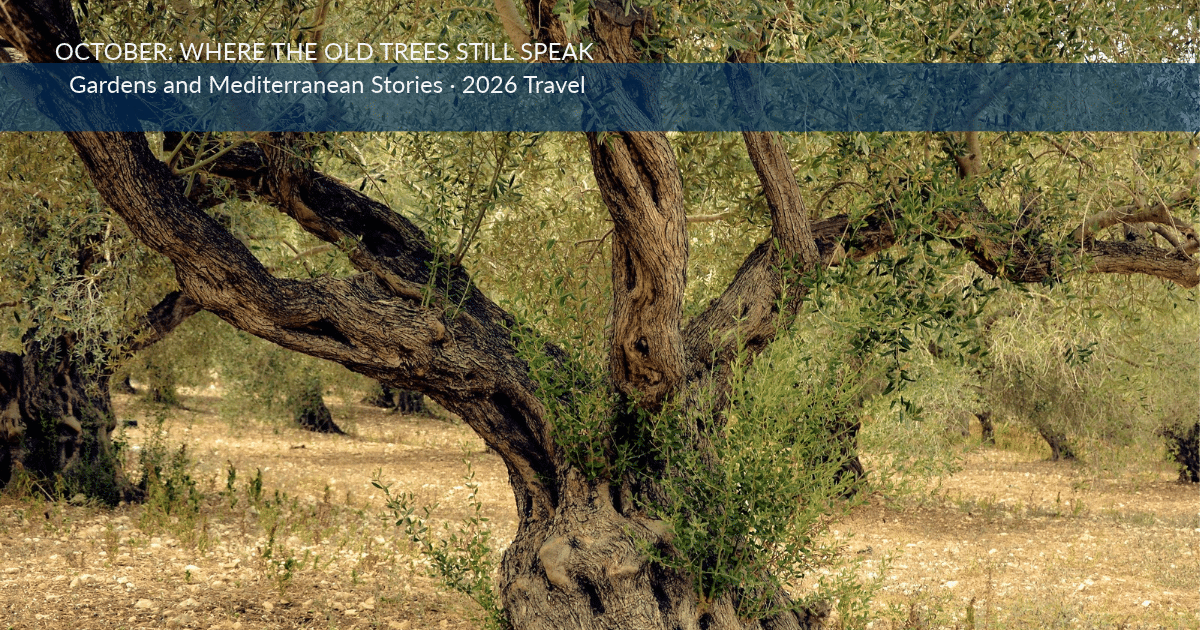
Andalusia’s Courtyards & Orange‑Grove Gardens: Where the Old Trees Still Speak
Marrakech & the World of Desert Gardens: Stories Written in Color
Amalfi & the Southern Italian Coast: Classics on the Cliffs
Contemporary Mediterranean Garden Design: When Everything Old Is New Again
INTRODUCTION

If you grew up like I did — a kid perched in a gnarled old apple tree, reading Greek myths — this is how you learn to see the gardens of the Mediterranean. In Homer, trees and shrubs weren’t just plants; they were gods and goddesses, and every flower carried a story. Those myths taught us that the Mediterranean is more than a place. It’s a feeling, a lineage, a world where stone and sun hold meaning you never quite forget.
Across the Mediterranean, gardeners have always worked with what the gods left behind: stone, sun, scarcity, slope, and never enough water. Today’s garden designers; from Athens to Marrakech to the Amalfi Coast are simply the newest mythmakers, using ancient lessons to build gardens that survive heat, drought, and the unpredictable moods of a changing climate.

When you finally arrive in Greece, Andalusia, Morocco, or the Italian coast, the landscapes feel familiar because the myths prepared you for them. The cliffs, the courtyards, the citrus, the blue shadows — they echo the stories you already know.
The reality is that the Mediterranean is a challenging place to garden. It is shaped by heat, drought, scarcity, stone, and intense seasonal light. The beauty we see today; the courtyards, rills, terraces, shade structures, tiled pavilions came from necessity. These gardens were engineered for survival long before they were admired for beauty.
Around the world, good gardeners work with the assets their climate brings them: stone for structure, water used sparingly but dramatically, shade as architecture, geometry to calm the eye, enclosure to create microclimates, terraces to conquer slope. These are not just decorative choices; they are climate solutions that became almost like poetry.
October is a month when the Mediterranean reveals itself with ease for the visitor. The heat lessens, the air clears, and you are visiting the gardens at a temperature that makes you eager to pull a weed. You can easily see how water cools the air, how shade creates comfort, how geometry creates serenity, how courtyards hold their own climate, and how terraces turn unpromising cliffs into gardens.

The pergola is a dual purpose garden feature. It provides shade for people and plants and it is structure to grow plants on.
The Theme This Month
This October series follows a monthly theme: Heat, Myth, Geometry, Water; a gardener’s Mediterranean. Each week explores a different expression of Mediterranean garden design, beginning with Andalusia, moving through Marrakech, rising to the Italian cliffs, and ending with contemporary dry gardens shaped by the same ancient logic.
Every week begins with an Explore block — a compact contents panel that orients the reader and sets the rhythm. I put one at the top of this note to show you what we will cover. Every article follows the same procedure: begin with place and feeling, explain the climate logic, show what to see and why it matters, connect it to the month’s theme, and offer a takeaway gardeners can use at home.
By the end of October, the Mediterranean will feel both romantic and practical too, a world shaped by myth, refined by climate, and understood through its gardens.

What You’ll Get from This Month’s Theme
Garden travel isn’t physically hard; but it is sensory‑rich. Too many terraces, courtyards, and “must‑see” spaces can create a sense of overload that sneaks up on even seasoned travelers. Shoulder‑season itineraries need breathing room, gentle pacing, and simple ways to reset the senses.
This plan builds those resets in from the start.
You’ll find:
- Quiet pauses between high‑detail gardens
- Low‑effort alternatives for days when travelers need a break
- Sensory resets that don’t rely on pastries or sugar
- A humane rhythm that respects how real people travel
It’s the difference between a trip you power through and a trip you savor.
WHAT YOU’LL EXPERIENCE EACH WEEK
Week 1 — Seville & Córdoba Courtyards, palace gardens, water, geometry, and the deep Andalusian tradition of shaping shade. A clear, structured beginning.
Week 2 — Marrakech A shift in palette and atmosphere: riad gardens, desert oases, and the iconic blue‑and‑cactus world of Majorelle. Your most immersive week.
Week 3 — Morocco’s Coast & Countryside A softer, slower stretch with olive groves, coastal breezes, and gardens that blend architecture with landscape. Built‑in recovery.
Week 4 — Southern Italy Terraces, citrus, cloisters, and warm late‑season light. A gentle landing that keeps the series coherent without the climate jump of Northern Italy.

Up Next
SOUTHERN SPAIN: ANDALUSIAN GARDENS
After Marrakech’s color, courtyards, and sensory immersion, the series moves north into Southern Spain, where Mediterranean garden logic becomes legible again — water, geometry, shade, and the long architectural tradition that shaped the region’s courtyards and palace gardens. Andalusia is where travelers begin to understand the Mediterranean, not just feel it. This next chapter brings you into Seville, Córdoba, and Granada, where the design principles behind the entire region come forward in clear, elegant detail.
📌 MYTH & MEANING Mediterranean Gardens in October
📌 HEAT, STONE & SHADE How Mediterranean Gardens Survive
📌 GEOMETRY & WATER Design Lessons from Andalusia to Amalfi
📌 GARDENS OF THE GODS Traveling the Mediterranean Through Myth
Further Reading
Gardens & Garden Skills
- Penelope Hobhouse — Gardening A classic for garden travelers. Her section on Islamic gardens is one of the clearest introductions to the geometry, water, and courtyard traditions you’ll see in Seville, Córdoba, and Marrakech.
- Monty Don — The Road to Morocco A warm, visual journey through Moroccan gardens, riads, and landscapes. Atmospheric and easy to dip into before Week 2 and Week 3.
- Louise Nicholson — The Gardens of Italy A beautifully photographed overview of Italian garden traditions — terraces, citrus, cloisters — perfect grounding before Southern Italy.
Architecture, Courtyards & Cultural Design
- George Michell — Courtyards: Aesthetic, Social, and Cultural Significance A richly illustrated look at courtyard traditions across cultures. Excellent grounding for Andalusia and Morocco.
- María Rosa Menocal — The Ornament of the World A cultural history of medieval Spain that explains the intellectual and artistic blending behind Andalusian architecture and gardens.
- Umberto Pasti — Eden Revisited: A Garden in Marrakech A lush, personal account of building and restoring a Moroccan garden — part memoir, part cultural study.
Narrative Travel & Cultural Atmosphere
- Peter Mayle — A Year in Provence Light, warm, and atmospheric. Not itinerary‑specific, but perfect for tuning into Mediterranean pace, humor, and sensory detail.
- Tahir Shah — The Caliph’s House A vivid memoir set in Casablanca. Wonderful cultural grounding before Marrakech and Morocco’s coast.
- Frances Mayes — Under the Tuscan Sun A classic for Southern Italy travelers — sensory, architectural, and deeply place‑driven.
Foodways, Culture & Everyday Life
- Claudia Roden — The Food of Spain A cultural cornerstone. Rich with history, regional traditions, and the sensory vocabulary of Andalusia — ideal before Week 1.
- Paula Wolfert — The Food of Morocco Deep, atmospheric, and beautifully researched. A perfect companion for Marrakech and Morocco’s coast.
- Katie Parla — Food of the Italian South Warm, approachable, and rooted in everyday culture — excellent grounding before Southern Italy.