
A Gardener’s Guide to the Netherlands’ Most Peaceful Hidden Places
SMALL GARDENS – BIG IMPACT
May, 11 2026 · In The Garden
- Designing Intimate Small Gardens
- The Hofjes of Holland: Courtyard Gardens of Care, Community and Medieval Charity
- How Estepona Spain Turned Itself Into a Garden
- Spanish Patio Gardens: Small-Space Lessons from Andalusia
What Are Hofjes?
Tucked behind ordinary streets and unassuming doorways, hofjes are small medieval courtyard communities — a ring of tiny houses built around a shared garden, originally created as charitable housing for poor or elderly women. Step inside one and the city noise falls away; what remains is a pocket of calm, symmetry, and centuries‑old care.
Many hofjes still serve their original purpose. Others are museums or protected heritage sites. All of them are living reminders of a society that believed caring for the vulnerable was a moral duty.

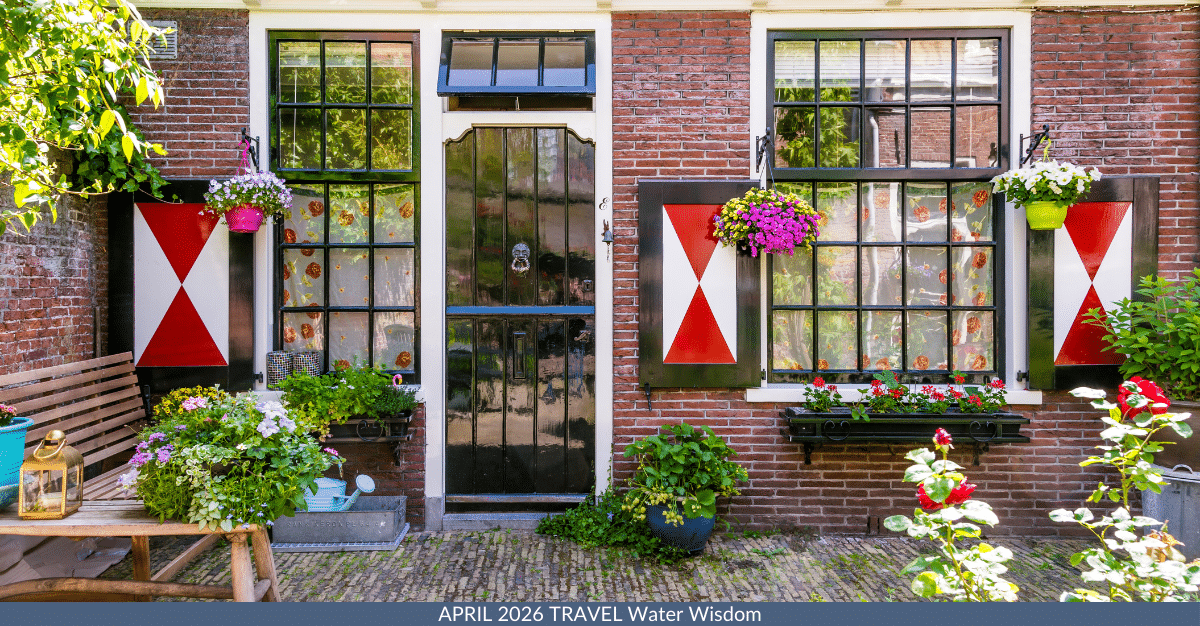
You may have noticed that while the hofjes are elegantly simpe the signage is very grand. The idea the donars had in mind was to balance social charity with the civic pride and religious beliefs of the Dutch Golden Age.
The Gardens: What Grew in These Courtyards
These were the everyday plants that supported cooking, healing, and comfort inside the small, enclosed courtyards.
I grow almost all of the plants on this list. My small herb garden is near the kitchen, I use these plants for cooking, appearance and scent. But look at what gardeners and cooks did with them before modern medicine.
- Sage — headache
- Thyme — antimicrobial; cooking
- Rosemary — headache; purification
- Lavender — calming; sleep
- Mint — digestion; respiratory relief
- Chamomile — stomach upset; gentle calming
- Comfrey — fractures; sprains
- Feverfew — “the aspirin of the Middle Ages”
In daily use, these everyday plants supported cooking, healing and comfort inside the small, enclosed courtyards. In daily life, they served as the backbone of cooking, healing and household fragrance. And in small enclosed courtyards, herbs like these thrived-valued for both practicality and scent.
For a slightly later example of a world famous medicinal garden, look to the Oxford Botanic Garden ( 1621) founded as an early physic garden. We visited it one summer on a canal and river boat trip. It is still performing its early objective – finding cures.
A Living Medieval Herb Garden
To understand how herbs once shaped daily life inside hofjes, it helps to look at a working medieval garden — one still tended much as it was centuries ago.

These were the kinds of herbs that thrived in small, enclosed courtyards — valued for healing, cooking, and daily household use.
🌸 2. Symbolic & Devotional Plants
Because many hofjes were founded by religious women, certain plants carried spiritual meaning and reinforced the charitable purpose of the community.
- Lily — purity
- Rose — charity
- Boxwood — steadfastness
- Ivy — fidelity
- Yew — eternal life
Flowers have always carried symbolic meaning for us. To learn more see the article below in Further Reading, it;s about medieval symbolism and written by a florist.
🍐 3. Fruit & Utility Plants
In these tiny courtyards, every wall and warm surface was used to grow food for winter storage and daily nourishment.
Medieval gardeners perfected techniques that maximized space:
- Espaliered apples or pears
- Currants
- Gooseberries
- Figs tucked into sheltered corners
To make the most of limited space, gardeners mastered “fruit walls.” using tall, south-facing brick walls to trap heat and create microclimates. Today we espalier for beauty and space-saving, they did it for every-day survival.
Here’s an example from Rousham in Oxford – the garden Monty Don has called the most beautiful in England, note this large fruit tree, trained flat against a warm brick wall. It looked like a fine crop to us, the garden volunteers gave us apples to eat with our picnic lunch.

A small, deliberate gesture in a garden shaped by patience.
Hofje gardeners used the same principles — warmth, shelter, and careful training — to grow fruit in small, protected spaces.
🌿 4. Shade Plants
The enclosed walls of a hofje created cool, sheltered pockets where shade‑loving plants thrived.
- Ferns
- Hellebores
- Hostas
- Hydrangeas (introduced later)
And even though hydrangeas aren’t medieval, you often find them pressed close to old walls in the Netherlands — a modern plant that feels completely at ease in historic settings.

A reminder that not every beloved plant needs a medieval past
In Dutch hofjes, the effect is similar: a generous plant placed against a warm wall adds softness, color, and a sense of welcome, even when the plant itself arrived centuries later
And once you start noticing how plants behave against walls — how they soften edges, catch light, and create small pockets of shelter — it becomes natural to look at the garden as a whole. Layout begins with these quiet relationships: where warmth gathers, where paths turn, and how each space invites you to move through it.
Garden Layout
Once you start paying attention to these small relationships — a plant leaning into warmth, a wall offering shelter — you begin to see how the whole garden is arranged. Layout isn’t just paths and borders; it’s the quiet dialogue between buildings and planting, the way architecture shapes space and the way plants soften it
- a central path or cross‑shaped layout
- a communal pump or well
- narrow beds along the walls
- benches for contemplation
- clipped hedges for structure
These gardens were not ornamental displays — they were sanctuaries.
Architecture: Medieval Simplicity, Dutch Restraint
In hofjes, this relationship is fundamental: the buildings create the enclosure, and the garden arranges itself within it, each shaping the other in quiet, deliberate ways. And once you see that, the architectural elements that make a hofje a hofje become unmistakable.
Gatehouses
Often the only visible part from the street:
- arched or stepped‑gabled entrances
- donor coats of arms
- inscriptions about charity
- biblical or moral mottos
Courtyards
Always inward‑facing:
- shared water
- brick paths
- small garden plots
- symmetry without grandeur
Houses
Originally:
- one room downstairs
- one room upstairs
- shared privies
Today:
- many still provide social housing
- some are museums
- some are private but open during posted hours
And at a certain point, layout becomes inseparable from architecture — the way a clipped hedge frames a view, the way a building anchors the space, and how one clear axis can hold the whole garden together.

In hofjes, this relationship is fundamental: the buildings create the enclosure, and the garden arranges itself within it, each shaping the other in quiet, deliberate ways.
The Long Charitable History
And behind all this structure — the walls, the gates, the careful geometry — was a purpose far deeper than design. Hofjes were physical expressions of the Seven Works of Mercy, a medieval framework for charitable action.
- Feed the hungry
- Give drink to the thirsty
- Clothe the naked
- Shelter the homeless
- Visit the sick
- Visit the imprisoned
- Bury the dead
They were also tied to the Seven Christian Virtues:
- faith
- hope
- charity
- prudence
- justice
- temperance
- fortitude
Charity (caritas) was the driving force behind hofje foundations — a belief that caring for the vulnerable was a sacred responsibility.
Where to See Hofjes Today
In the present day, hofjes are scattered across the Netherlands, some hidden in quiet residential streets, others opening directly onto lively city squares. A few towns have preserved them especially well.
Haarlem — The Capital of Hofjes
Haarlem has the largest and most beautiful concentration of hofjes in the Netherlands.
- Hofje van Bakenes (1395) — the oldest
- Hofje van Oorschot — elegant and peaceful
- Hofje van Loo — classic layout
- Hofje van Guurtje de Waal — small and intimate
Leiden — Academic and Historic
- Hofje van Brouchoven
- Hofje van Splinter
- Hofje van Nieuwkoop
Amsterdam — Hidden Behind Busy Streets
- Begijnhof
- Hofje van Brienen
- Hofje van de Zeven Keurvorsten
Utrecht
- Hofje van Heiligenberg
- Hofje van Liefde
Other Towns
Gouda, Delft, Alkmaar, Hoorn, Dordrecht — each has at least one preserved hofje.
If your spring travels take you along the Tulip Trail, pause for the hofjes. They’re small, sheltered worlds that reveal a quieter side of each town.
A Full Hofje Garden in Bloom
Some hofjes offered more than quiet corners — they created full, flourishing gardens where residents could sit, talk, and enjoy the changing seasons together.

Benches and tables offered residents a peaceful place to rest, read, or share the day.
In many cases, gardens like this balanced beauty with purpose-and many hofjes also planted species chosen for their symbolic or devotional meaning.
Take Haarlem’s Hofje Walk
Photograph this card and take it with you.

Start: Haarlem Station
Walk toward the quieter residential streets.
Stop 1: Hofje van Bakenes (1395)
Look for the stepped‑gable entrance and inscription about charity.
Stop 2: Hofje van Oorschot
Clipped hedges, central path, and a deep sense of calm.
Stop 3: Hofje van Loo
Still inhabited; look for the communal pump and narrow beds.
Stop 4: Hofje van Guurtje de Waal
Small, intimate, atmospheric.
Optional: Begijnhof
A larger complex originally for religious women.
End: Grote Markt
Finish with a quiet moment in the square.
How to Visit the Hofjes
For visitors, because many hofjes are still homes:
- enter quietly
- avoid photographing residents
- stay on paths
- respect posted hours
- treat the space as a living community
In Haarlem, one day my husband, with his camera, was approached by a local woman who explained very precisely that he wan NOT to take her photo!
Reflection
Hofjes are small places with large meaning. They remind us that gardens can be acts of care, that architecture can shelter the vulnerable, and that charity can be built into the very structure of a city. In these courtyards, centuries of women found safety, community, and beauty — and visitors today can still feel that quiet strength.
Why women, and not indigent men? We were told that Dutch leaders of the time, were convinced that men, alone could not maintain themselves. They were put in group homes. Evey society has its viewpoints!
Up Next: Week 3 of Small Gardens — Big Impact
Next week, we’ll head to southern Spain to explore the Andalusian patio garden — a shared courtyard tradition where families care for the plants together, decorate the walls with vertical planters, and often gather for meals beneath the vines.
📌 THE HOFJE ROUTE
📌 HIDDEN GARDENS
📌 A CITY OF LOVELY DOORWAYS
📌 THE GENTLE RHYTHM OF HAARLEM’S HOFJES
Quick Answers:
Happy Digging,
Jane
Further Reading
Article
The Language of Flowers: Symbolism in Medieval and Modern Floristry
A florist’s exploration of how flowers have carried meaning across centuries — from religious iconography to contemporary bouquets.
(
Book
The Medieval Garden — Sylvia Landsberg
A richly illustrated look at how medieval Europeans designed, planted, and understood their gardens.
Video
Hofjes and Hidden Courtyards of the Netherlands
A short, atmospheric documentary walking through several preserved hofjes and their gardens.
How to find it:
Go to YouTube and search for:
Hofjes and Hidden Courtyards of the Netherlands documentary
(It appears under that title and features multiple courtyard tours.)