
Explore These:
WEEK 1 — ANDALUSIA’S COURTYARDS & ORANGE GROVES
Andalusia’s Courtyards and Orange‑Grove Gardens Where the Old Trees Still Speak
WEEK 2 — MARRAKECH & THE WORLD OF DESERT GARDENS
Marrakech and the World of Desert Gardens Stories Written in Color
WEEK 3 — THE ITALIAN RIVIERA & AMALFI
The Italian Riviera and Amalfi’s Coastal Gardens Classics on the Cliffs
WEEK 4 — CONTEMPORARY MEDITERRANEAN GARDEN DESIGN
Contemporary Mediterranean Garden Design When Everything Old Is New Again
INTRODUCTION

Explore this Week:
SEVILLE’S ALCÁZAR COURTYARDS Mudéjar Geometry and Citrus Shade
GRANADA’S GENERALIFE TERRACES Water, Light, and Islamic Garden Grammar
THE ALHAMBRA’S PALACE GARDENS Geometry, Cooling Logic, and Mountain Air
THE ANDALUSIAN COURTYARD TRADITION Pots, Tile, Shade, and Domestic Ease
Start October Under Andalusia’s Old Trees
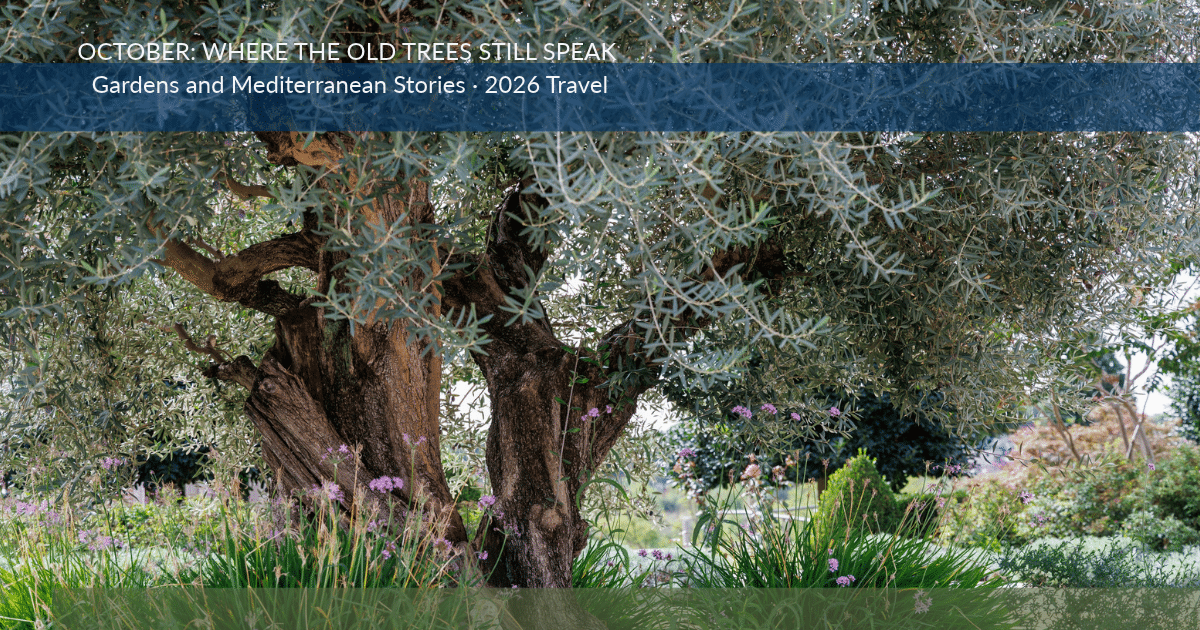
You can learn a lot about a place by how they value their old trees. Cultivated olive trees in Spain last 300-600 years. They can last 1000 years and they keep bearing fruit. That gives us a sense of timelessness.
October opens in Andalusia with the feeling that the old trees still speak. Their trunks twist like script, their leaves catch river or mountain light, and their shade carries centuries of cooling wisdom. This first travel week in southern Spain sets a foundation under everything we will learn about gardening in this climate.

Andalusia is the western gateway to Mediterranean garden logic — a place where Islamic, Christian, and local traditions blended into a climate‑wise design language. Shade becomes architecture, water becomes geometry, and courtyards become living rooms. This week teaches you how Mediterranean gardens think before you travel deeper into the region.
We know that cultivated olive trees can have extremely long lives and keep bearing fruit. Their trunks twist like script, their leaves catch river or mountain light, and their shade carries centuries of cooling wisdom. This first travel week in southern Spain sets a foundation under everything we will learn about gardening in this climate.
You land in Seville, the river city of citrus courtyards, tiled basins, palms, and promenades. It’s warm, fertile, and open — the perfect place to breathe in the ease of Andalusian life.
Then you travel east to Granada, where the Nasrid Dynasty built the Alhambra and Generalife high above the city. Here, water, shade, geometry, and enclosure formed the grammar of Mediterranean garden design. Granada is the origin point — the place where everything begins.
Everything you’ll see later in Marrakech, the Italian Riviera, and contemporary Mediterranean design traces back to the principles refined here: enclosure, proportion, water movement, and the cooling intelligence of trees.
Returning to Seville at the end of the week lets you feel how that grammar evolved into the Andalusian courtyards, promenades, and public gardens that shape the city today.

You will visit places where the street trees provide fruit but it is best not to be tempted to eat one. These are the oranges that bring us marmelade and extreme tartness is a feature of good marmelade oranges but not for eating fresh.
DAYS 1–2 — SEVILLE: Arrival, Alcázar, and the Ease of Andalusian Courtyards
Day 1 — Real Alcázar: Mudéjar Geometry and Citrus Shade
Your October begins at the Real Alcázar, where Mudéjar craftsmen blended Islamic garden traditions with Christian architecture. This is where you first see how Mediterranean gardens breathe — rooms opening directly into courtyards, water cooling the air, citrus trees forming shade, and tilework reflecting heat and myth.

The Alcázar teaches you how Islamic garden principles adapt to warmer, flatter terrain. Water becomes a cooling system. Shade becomes architecture. Courtyards become microclimates. Every space feels intentional, layered, and climate‑true.
Southern Spain’s historic gardens are built around a simple, climate‑wise vocabulary: enclosed courtyards that trap cool air, shaded passages that protect you from the midday sun, and water used as a quiet tool for comfort. Rills carry water in narrow channels that cool the air as they move; fountains and basins add sound and stillness. Architecture shapes every garden space with carved stucco, tilework, arches, and geometric proportion. Look for citrus, pomegranates, myrtle, roses, vines, palms, oleander, and olives — the structural plants that define Andalusia’s garden identity.

The four pathways symbolize the four rivers of paradise, and the lower fountain reflects the upper, doubling the visual impact of the water and makes reference to heaven and earth.
You will quickly assimilate how Moorish architecture and garden design became an Andalusian form. The area experienced many centuries of Moorish rule, and the style adapted beautifully to the challenges of the local climate.
Day 2 — Santa Cruz: Domestic Courtyards and Andalusian Ease
Spend your second day wandering Santa Cruz, where narrow lanes open onto glimpses of private courtyards. Terracotta pots, citrus trees, tiled floors, and the interplay of shade and brightness define the Andalusian way of life.
Image Placement: Domestic courtyard with pots + citrus — medium landscape (1400–1800 px).
Courtyards teach you how to garden in tight spaces — how to use pots, tile, water, and shade to create coolness and beauty. They show how domestic gardening evolved from Islamic principles into everyday Andalusian culture.
This is the day your readers understand how Seville lives its garden heritage — not as museum pieces, but as lived‑in, practical cooling systems.
Leaving Seville’s river light and citrus courtyards prepares you for Granada’s mountain clarity — a shift from domestic ease to architectural depth.
DAYS 3–5 — GRANADA: The Origin Point of Mediterranean Garden Logic
Day 3 — Generalife: Water as Geometry, Shade as Architecture
Travel east to Granada, where mountain light sharpens edges and cool air slips through cypress. Begin at the Generalife, the Nasrid dynasty’s terraced garden retreat.
Morning light catches the rills, clipped myrtles, and tiled basins. Water guides you through terraces. Shade becomes architecture. Courtyards feel like private worlds. This is Islamic garden design in its purest form — water used not for spectacle but for orientation, cooling, and quiet sound.
Generalife resets your senses for the month ahead.
Image Placement: Generalife terraces + rills — wide landscape (1800–2200 px).
Day 4 — The Alhambra: The Emotional and Architectural Anchor of October
Spend your fourth day in the Alhambra, the emotional anchor of your entire October. Move slowly between palace rooms, courtyards, and gardens. Water cools the air. Geometry creates serenity. Planting supports architecture rather than competing with it.
Image Placement: Court of the Lions or reflective pool — wide landscape (1800–2200 px).
Key moments include the Court of the Lions, the reflective pools, and the Partal — places where Islamic water geometry feels alive and present. The Alhambra teaches you why Mediterranean garden design works — the origin, the intimacy, the cooling logic.
Image Placement: Partal tower + reflecting pool — medium landscape (1400–1800 px).
Day 5 — The Albayzín: Cármenes and the Art of Terraced Living
The Albayzín’s narrow lanes open onto glimpses of cármenes — private homes with terraced gardens overlooking the city. Even short views teach you how Granada blends architecture, horticulture, and mountain air.
Carmen gardens show how to garden on slopes, how to use walls for microclimates, and how to frame views with foliage. They reveal how terraces manage heat, how shade becomes structure, and how enclosure creates privacy.
End the day with a quiet overlook toward the Alhambra. October light makes the walls glow.
Image Placement: Terrace overlooking the Alhambra — wide landscape (1800–2200 px).
DAY 6 — RETURN TO SEVILLE: Promenades, Palms, and Public Garden Rhythm
Return to Seville for a day devoted to María Luisa Park and Plaza de España. Broad promenades, tiled benches, palms, fountains, and long axial views create a breezy, relaxed rhythm. Plaza de España glows in October light.
Image Placement: Promenade with palms + tiled benches — wide landscape (1800–2200 px).

This day is a masterclass in public garden design — how to create shade, movement, and social space at scale. It shows how Andalusian garden logic evolved from intimate courtyards into expansive public landscapes.
A FINAL CHOICE TO SHAPE YOUR WEEK
ANDALUSIA — WEEK 1 TRAVEL PLAN (OCTOBER)
DAY 1 — SEVILLE
Real Alcázar
Mudéjar geometry, citrus shade, cooling water channels
(“rooms opening directly into courtyards, water cooling the air”)
DAY 2 — SEVILLE
Santa Cruz Courtyards
Pots, tile, domestic shade, everyday Andalusian cooling
(“terracotta pots, citrus trees, tiled floors”)
DAY 3 — GRANADA
Generalife
Terraces, rills, water as geometry, quiet shade
(“water guides you through terraces… shade becomes architecture”)
DAY 4 — GRANADA
Alhambra
Reflecting pools, Court of the Lions, carved stucco
(“the emotional anchor of your entire October”)
DAY 5 — GRANADA
Albayzín Cármenes
Terraced gardens, microclimates, framed views
(“private homes with terraced gardens overlooking the city”)
DAY 6 — SEVILLE
María Luisa Park & Plaza de España
Promenades, palms, tiled benches, public garden rhythm
(“breezy, relaxed rhythm… expansive public landscapes”)
DAY 7 — CHOOSE YOUR FINALE
Carmona — 25 min from Seville, hilltown wander, 3–5 hrs
Itálica — 12–15 min from Seville, Roman ruins, 2–3 hrs
Your last day in Andalusia offers two distinct endings, each fully doable from Seville. Choose between a quiet hilltown finale or a dramatic archaeological close — both within easy reach, both offering a different emotional tone for the end of Week 1.
CARMONA
A quiet hilltown finale about 25 minutes from Seville, offering a warm, scenic close to the week. Carmona is a half‑day wander through ridge‑top views, stone streets, and small architectural details. Expect moderate energy with gentle hills and time to explore at an unhurried pace. Most travelers spend 3–5 hours here, making it fully doable in a single day and ideal for readers who want an atmospheric, slow‑travel ending.
ITÁLICA
A dramatic archaeological finale only 12–15 minutes from Seville, perfect for a lighter, more structured close to the week. Itálica’s Roman amphitheater, mosaics, and open site layout create a low‑energy, 2–3 hour visit on flat ground. It’s the quickest, easiest option — fully doable in a single day and especially suited to readers who want a concise, educational ending without the lift of a hilltown.

If you have not had an opportunity to wander in a Roman ruin you will find this fascinating. They make you feel you can visualize a very different life.
Up Next:
Quick Questions and Answers
Q1: Why is Granada considered the origin point of Mediterranean garden design? A: Granada is where Islamic garden grammar was refined — water used for cooling, geometry for serenity, and shade as architecture. As your article notes, “water cools the air, geometry creates serenity, and planting supports architecture.”
Q2: What makes the Generalife a must‑see garden in Granada? A: The Generalife is the Nasrid dynasty’s terraced retreat, famous for rills, clipped myrtle, tiled basins, and quiet shade. It shows how water guides movement and creates microclimates across terraces.
Q3: What should travelers look for in the Alhambra’s gardens? A: Key moments include the Court of the Lions, reflective pools, and the Partal. These spaces reveal how Islamic water geometry shapes calm, cooling garden rooms and how architecture and planting work together.
Q4: What are cármenes, and why are they important in Granada? A: Cármenes are private homes with terraced gardens overlooking the city. They demonstrate how Granada uses walls, slopes, and enclosure to create microclimates, framed views, and cool, livable outdoor rooms.
Q5: How does Granada’s mountain setting influence its gardens? A: Mountain light sharpens edges, cool air moves through cypress, and terraces manage heat. The elevation creates natural ventilation and clarity, making Granada’s gardens feel intimate, bright, and climate‑wise.
Glossary
Nasrid Dynasty — The last Muslim rulers of Granada (13th–15th c.), creators of the Alhambra and Generalife.
Generalife — The Nasrid kings’ summer garden retreat, known for rills, terraces, and cool shade.
Mudéjar — A Spanish architectural style blending Islamic design with Christian buildings.
Alhambra — A palace‑fortress in Granada famous for courtyards, reflecting pools, and carved stucco.
Photo Credits
Bird Mosaic: PEPE GADEIRAS, CC BY-SA 4.0 https://creativecommons.org/licenses/by-sa/4.0, via Wikimedia Commons
Further Reading
Articles
Historic Gardens of Southern Spain
Books
Gardens of the Alhambra — D. Fairchild Ruggles
Islamic Gardens and Landscapes — D. Fairchild Ruggles
The Art of the Islamic Garden — Emma Clark
Gardens of Spain — Rosemary Bailey
Water and Architecture — Charles W. Moore
Courtyard Houses of Spain — Geoffrey Maizels
The Ornament of the World — María Rosa Menocal
Moorish Spain — Richard Fletcher