
EXPLORE THIS MONTH:
EXPLORE — October in the Mediterranean
Andalusia’s Courtyards & Orange‑Grove Gardens: Where the Old Trees Still Speak
Marrakech & the World of Desert Gardens: Stories Written in Color
Amalfi & the Southern Italian Coast: Classics on the Cliffs
Contemporary Mediterranean Garden Design: When Everything Old Is New Again
EXPLORE — Week 3: Amalfi & The Southern Italian Coast
Classics on the Cliffs

Southern Italy’s Vertical Gardens
Lemon Pergolas • Chestnut‑Wood Shade • Terraces Toward the Sea

Ravello Terraces
Villa Cimbrone • Villa Rufolo • Cliffside Garden Rooms

Giardini della Minerva — Day 3
Medicinal Terraces • Volcanic Soil • Monastic Water Channels

Abbazia di Cava de’ Tirreni — Day 4
Herb Traditions • Quiet Cloisters • The Order Behind Terrace Gardening

Amalfi & Minori Lemon Terraces
Chestnut‑Wood Pergolas • Lantern‑Bright Lemons • Shade Corridors

Capri Gardens
Gardens of Augustus • Villa San Michele • Stonework & Sea Air

Departure
Volcanic Fertility • Rosemary on the Breeze
INTRODUCTION

Discover the beauty of Amalfi Coast gardens, where fragrant citrus groves, colorful bougainvillea, and historic villa landscapes overlook the sparkling Mediterranean. From hidden garden retreats to world-famous botanical treasures, these gardens showcase the unique charm of Italy’s most celebrated coastline.
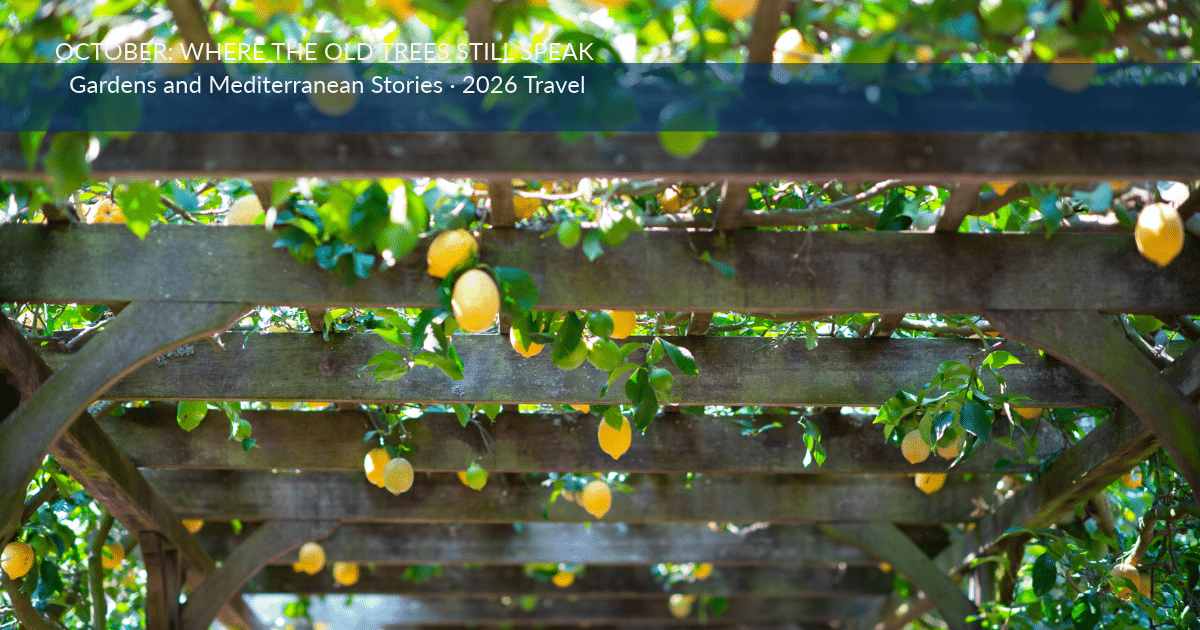
Southern Italy’s vertical gardens begin with lemons; no surprise, but they are not just fruit, they use them as shade-producing elements of garden architecture. Across the Amalfi and Sorrento coasts, steep hillsides are carved into terraces held by ancient stone walls, and on each terrace stands a pergola built from pale, durable chestnut wood. These pergolas are woven with lemon trees — espaliered, lifted, and trained so the orchard becomes a kind of living colonnade. Walking through them feels like stepping inside a citrus cathedral: beams overhead, sunlight filtering through leaves, and the warm scent of lemons drifting along the stone paths. No technology, no A/C but who would not love this on a hot day.
This is where the Mediterranean garden becomes truly vertical. The pergola is the structure, the lemon is the ornament, and the terrace is the stage. Together they create a landscape that is agricultural, architectural, and irrepressibly romantic. It’s a garden held up by timber and citrus, shaped by centuries of coastal ingenuity. The lesson? Live with your climate and you’ll do fine! This week is about climbing upward, slowing down, and learning how hillside gardens breathe, through terraces, pergolas, herbs, orchards, and the constant presence of the sea
Don’t Overlook the Volcanic Soil!

Southern Italy’s vertical gardens don’t rise from ordinary earth — they grow from volcanic soil, one of the most generous mediums a gardener can work with. The eruptions of Vesuvius and the Phlegraean Fields left behind mineral‑rich ash that feeds citrus, olives, herbs, and vines with slow, steady abundance. This soil holds moisture, releases nutrients gradually, and gives lemons their intensity and herbs their clarity. When you walk the terraces above Amalfi or Sorrento, you’re walking on centuries of volcanic fertility — a landscape where renewal follows destruction, and gardens thrive because the ground itself is still warm with history.
Volcanic soils create this same quiet vigor in other places shaped by fire. Santorini’s basket‑trained vineyards, Sicily’s pistachio and citrus orchards, and the Canary Islands’ lava‑cradle vines all grow from mineral‑rich ash that behaves almost like a natural slow‑release fertilizer. And far from the Mediterranean, Hawaii’s young volcanic earth produces tropical fruit and foliage with the same unmistakable intensity — a perfect place to explore how gardeners work with fresh, living soil.
For what we appreciated about eating fresh in Hawaii try this.
DAY 1 — ARRIVAL + FIRST TERRACE GARDEN
Arrive in Naples or Salerno and step immediately into the rhythm of terraces. Choose a simple garden for your first stop: citrus trees trained onto chestnut pergolas, stone paths rising gently, and the scent of lemons warming in the sun. This is your introduction to Southern Italy’s vertical logic — how the land rises and the plants follow. Garden Lesson: learn to live with your climate and you’ll do fine!
DAY 2 — AMALFI COAST LEMON TERRACES

Spend the day exploring Amalfi’s cliffside gardens. Here, the famous lemon pergolas stretch across steep slopes, creating long corridors of shade and scent. The chestnut beams shade you from above and the lemons glow like lanterns in the filtered light. Walk slowly, these gardens are about resilience, fragrance, and the feeling of being suspended between land and sea. Garden Lesson: This is still a tough climate, look for resilient plant materials.
DAY 3 — MONASTIC HERB TRADITIONS

Travel inland to a monastic garden shaped by centuries of herbal knowledge. These hillside spaces are orderly, terraced, and deeply rooted in healing traditions. You’ll see thyme, sage, lavender, and medicinal plants arranged in geometric beds, each terrace a chapter in a long botanical story. Garden Lesson: Herb gardens are restful spaces, create a beautiful orderly one, you will use it often.
You can see this Medieval garden in New York of all places. The picture is the Bonnefont Medieval Herb garden at the Cloisters, the Medieval branch of the Metropolitan Museum of Art. You will see many species of plants that made life livable in the Middle ages. You will be surprised by what they had.
For medieval gardens designed as community based charities see this article. Fascinatingly, we visited some that are still in their original use.
DAY 4 — VERTICAL VINES + PERGOLAS

Today is about shade architecture. Visit gardens where pergolas carry grapes, wisteria, or bougainvillea overhead. The light shifts constantly — a moving pattern of sun and shadow that cools the air and frames the view. These pergolas echo the agricultural pergolas of the lemon terraces, but with a softer, more ornamental touch. Garden Lesson: Pergolas are living ceilings. They cool the air and shape the experience of the garden. You can use them everywhere, check the photo group for their diverse uses. Do you need one?
We all do romanticize the Mediterranean region, and artists are no exception. This painter, Harald Schumacher, eptiomizes the 19th century view, of the region, as romantic as you could want.
DAY 5 — CITRUS GROVES + WATER LOGIC
Explore a citrus grove where water is guided through channels, basins, and terraces. The basic rule of Mediterranean gardens apply, direct and savor every b. Watch how water moves from terrace to terrace, feeding lemons, herbs, and vines with quiet precision. Garden Lesson: Mediterranean gardens thrive on controlled water, they don’t expect abundance.
DAY 6 — HILLSIDE GARDEN + SLOW AFTERNOON
Choose a hillside garden with long views. Sit under a pergola, listen to the wind move through olive trees, and let the afternoon stretch. This is the quiet heart of the week — a moment to absorb the vertical landscape and the way it slows you down. Garden Lesson: Hillside gardens teach patience
DAY 7 — COASTAL GARDEN + DEPARTURE

Your final morning deserves a garden that feels like an exhale — quiet terraces, citrus warmed by the sun, and the sea just beyond the stone walls. Head to Giardini della Minerva in Salerno, one of Europe’s oldest terraced medicinal gardens. It’s small, serene, and beautifully vertical, with narrow paths that lead you upward through herbs, citrus, and cooling shade. From the top terrace, the Tyrrhenian Sea opens like a blue page. The garden isn’t grand; it’s intimate — the kind of place where you hear your own footsteps and you get that little scent of rosemary on the breeze. Garden Lesson: A great gardener said that “gardeners are optimistic, energetic and never satisfied.” But these hot, dry gardens teach us to slow down and appreciate what we create.
Conclusion
Southern Italy’s gardens teach you to look upward — to follow terraces, pergolas, and orchards as they climb the land. They are agricultural, architectural, and deeply human, shaped by centuries of ingenuity and a climate that rewards discipline. By the end of the week, you understand the vertical Mediterranean garden not as a style, but as a way of living with land, light, and heat. You leave slower, steadier, and scented faintly of lemons.

Up Next
Italian gardens perfected the balance between architecture, water, and landscape centuries ago, but Mediterranean garden design continues to evolve. Today’s designers are reinterpreting traditional elements with clean lines, sustainable planting, and outdoor spaces designed for modern living.
Next week, we’ll explore Contemporary Mediterranean Gardens, where timeless regional influences meet twenty-first century design, creating landscapes that are both beautiful and remarkably practical for today’s gardeners.
Continue the journey as we discover how modern designers are shaping the future of Mediterranean gardens while honoring their rich heritage.
Quick Questions and Answers
What is the defining feature of an Italian garden?
Italian gardens are known for their formal layout, symmetrical design, terraces, fountains, and carefully clipped hedges. These gardens blend architecture and landscape into a unified outdoor space.
Why do Italian gardens include so many fountains and water features?
Water symbolizes both beauty and engineering in Italian garden design. From grand cascades to small fountains, water adds movement, sound, and cooling effects while serving as a focal point within the landscape.
Which plants are commonly found in Italian gardens?
Classic Italian gardens often feature cypress trees, boxwood hedges, olive trees, roses, lavender, citrus, and aromatic herbs that thrive in Mediterranean climates.
Can gardeners adapt Italian garden principles to small spaces?
Yes. Even a small courtyard or patio can capture the spirit of an Italian garden through geometric layouts, containers, a focal feature such as a fountain, and a restrained plant palette.
Which famous Italian gardens are worth visiting?
Notable examples include the Villa d’Este in Tivoli, the Boboli Gardens in Florence, Villa Lante in Bagnaia, and the gardens of Isola Bella on Lake Maggiore. Each showcases a different interpretation of Italian garden design.
Photo Credits
Harald Schumacher DanishDaderot, CC0, via Wikimedia Commons
Mt Vesuvius Gary Todd from Xinzheng, China, Public domain, via Wikimedia Commons
Miguel Hermoso Cuesta, CC BY-SA 4.0 https://creativecommons.org/licenses/by-sa/4.0
Gardens of Augustus Deror_avi, CC BY-SA 4.0 https://creativecommons.org/licenses/by-sa/4.0, via Wikimedia Commons
Further Reading
Gardens of the Amalfi Coast
A beautifully illustrated overview of the region’s most significant gardens, including Ravello, Capri, Sorrento, and Naples.
- Gardens of the Amalfi Coast (overview and inspiration)
- https://www.sussexgardenstrust.org.uk/article/gardens-of-the-amalfi-coast-italy [sussexgard…ust.org.uk]
Villa Cimbrone, Ravello
The most famous garden on the Amalfi Coast, known for the Terrace of Infinity.
- Villa Cimbrone Official History & Gardens
- https://www.hotelvillacimbrone.com/villa-cimbrone/ [hotelvilla…mbrone.com]
- Grandi Giardini Italiani: Villa Cimbrone
- Excellent information on the garden’s history, plant collections, and design evolution.
- https://www.grandigiardini.it/lang_EN/308-visit-Villa-Cimbrone-event-tickets [grandigiardini.it]
Villa Rufolo, Ravello
The garden that inspired Wagner’s vision of Klingsor’s enchanted garden in Parsifal.
- Ravello: Villa Rufolo & Villa Cimbrone
- https://amalficoast-travel.com/en-us/amalfi-coast/ravello/ [amalficoas…travel.com]
- Villa Rufolo and Villa Cimbrone: Wonders to Discover in Ravello
- https://movery.it/en/villa-rufolo-e-villa-cimbrone-meraviglie-da-scoprire-a-ravello/ [movery.it]
Recommended Books
1. Gardens of the Amalfi Coast
Author: Robert I. C. Fisher
Publisher: Frances Lincoln
Publication Year: 2015
A photographic and historical survey of twenty-four significant gardens in Campania, including Ravello, Capri, Positano, and Sorrento. Probably the single best book focused directly on your article topic. [abebooks.com], [ebay.com]
2. Close to Paradise: The Gardens of Naples, Capri and the Amalfi Coast
Author: Robert I. C. Fisher
Publisher: Frances Lincoln
Publication Year: 2011
The original larger-format edition of the above work. Covers horticultural history as well as the writers, artists, and aristocrats associated with these gardens. [amazon.co.uk]
3. Italian Gardens
Author: Georgina Masson
Publisher: Abrams (later editions by ACC Art Books)
A classic reference covering the development of Italian gardens from the Renaissance through later periods. Valuable for placing Amalfi gardens within the broader Italian tradition. [abebooks.com], [issuu.com]
4. Italian Villas and Their Gardens
Author: Edith Wharton
Publisher: Century Company (1904)
A garden-writing classic. While not Amalfi-specific, it remains one of the most insightful discussions of Italian garden design philosophy. [abebooks.com]
5. Private Italian Gardens
Author: Paolo Pejrone
Publisher: Rizzoli
Useful for understanding the intimate Mediterranean character of Italian gardens and their relationship to architecture and landscape. [eyeofthedaygdc.com]
Videos
Ravello Italy | Amalfi Coast Gardens and Panoramic Views
A focused look at Villa Rufolo, Villa Cimbrone, and Ravello’s garden culture.
- https://www.youtube.com/watch?v=CVhtKMn0NOU [youtube.com]
The Best of Ravello, Italy: Exploring the Amalfi Coast’s Most Beautiful Gardens
Excellent footage of Villa Cimbrone and Villa Rufolo with extensive garden views.
- https://www.youtube.com/watch?v=inU32x3wm_w
Ravello Iconic Cliffside Gardens Walking Tour (4K)
Useful for studying paths, plantings, vistas, and visitor experience.
- https://www.youtube.com/watch?v=XaiBaB7wPmo