
Explore These:
Introduction to Mediterranean Gardens
WEEK 1 — ANDALUSIA’S COURTYARDS & ORANGE GROVES
Andalusia’s Courtyards and Orange‑Grove Gardens Where the Old Trees Still Speak
WEEK 2 — MARRAKECH & THE WORLD OF DESERT GARDENS
Marrakech and the World of Desert Gardens Stories Written in Color
WEEK 3 — THE ITALIAN RIVIERA & AMALFI
The Italian Riviera and Amalfi’s Coastal Gardens Classics on the Cliffs
WEEK 4 — CONTEMPORARY MEDITERRANEAN GARDEN DESIGN
Contemporary Mediterranean Garden Design When Everything Old Is New AgainINTRODUCTION
Explore This Week
WEEK THREE — MARRAKECH
Majorelle
Menara
Riad Gardens
Color Logic
Shade & Silence
How to See Them
Garden Lessons
Getting Around
Safety
INTRODUCTION
Visit Marrakesh Gardens to discover a quieter side of Morocco’s famous Red City. Marrakesh is often celebrated for its bustling souks, ancient medina, and vibrant palaces, but beyond the city’s red clay walls lies another treasure: a collection of extraordinary gardens. From the iconic Jardin Majorelle with its striking cobalt-blue accents to the historic Menara Gardens framed by the Atlas Mountains, these green spaces offer a refreshing escape from the heat and energy of the city. Whether you are searching for botanical beauty, cultural history, or peaceful places to wander, the gardens of Marrakesh reveal a side of Morocco that is both enchanting and deeply connected to centuries of landscape design.
Around here, shade becomes architecture and light and shadow become a design language. Color becomes structure, especially cobalt blue, which behaves like painted shade. Water appears sparingly, anchoring space rather than decorating it. Palms, olives, cactus, bamboo, and bougainvillea are chosen not only for beauty but also for endurance, thriving in a climate where resilience is essential.
MAJORELLE — THE GARDEN THAT HELPS YOU TO SEE

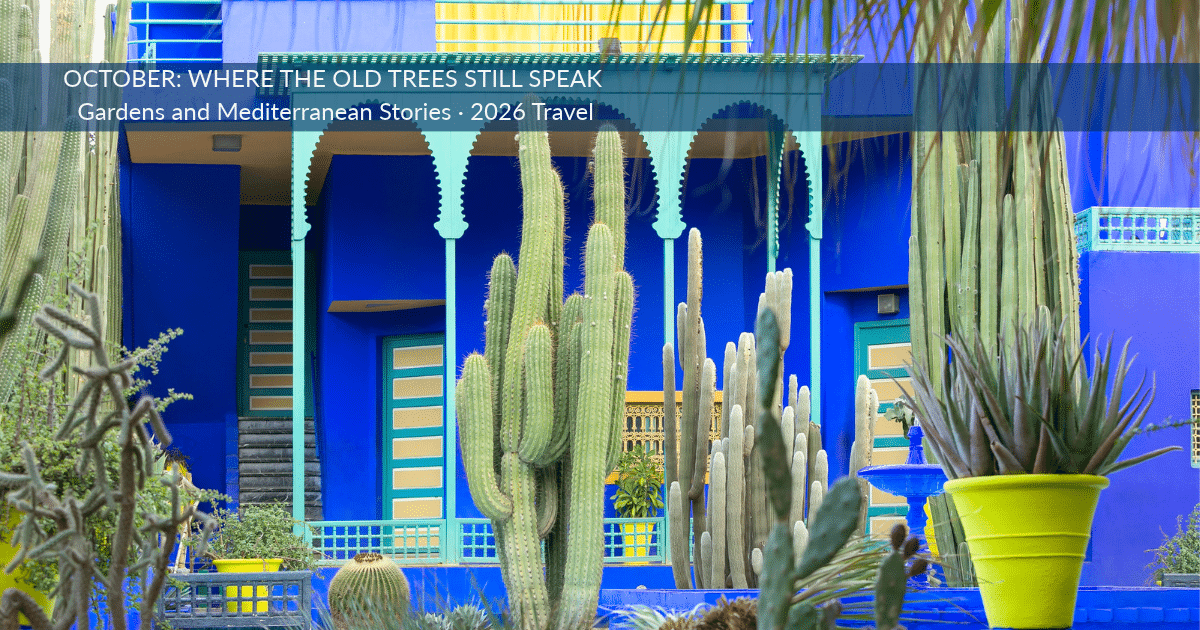
Majorelle is the most famous garden in Marrakech, but it’s also the most useful for gardeners: a place where color, shadow, and structure are used with painterly intention. And they love color.
Created in the 1920s by Jacques Majorelle (3/7/1886–10/14/1962), a French artist obsessed with light and cobalt blue, the garden was later restored by Yves Saint Laurent and Pierre Bergé, who preserved Majorelle’s color logic and architectural plantings. Today, it’s a bold space of palms, bamboo, cactus, pottery, and still water — all held together by that unmistakable cobalt glow.
Why Cobalt Blue?
In Majorelle, cobalt isn’t just a color choice; it’s a Mediterranean inheritance. The region is rich in natural cobalt deposits, and every culture has used it. The ancient Romans colored their glass with deep blue, Greeks painted doors and shutters to cool the eye, and Moroccan artisans turned cobalt into pottery glazes and architectural accents. In the strong desert light, cobalt behaves like shade you can paint — cooling, clarifying, and giving the garden a sense of depth that feels both ancient and modern.
Once you see it here, you’ll start noticing blue everywhere — doors, pottery, shutters, tiles. It’s a vein of ore that runs throughout your whole trip. Shades of blue cool Mediterranean homes and gardens, and you’ll see wonderful variations in different locales. You can use some in your own garden, but in Marrakech you’ll see the most vivid.
Majorelle may not seem approachable at first — the crowds, the fame, the fashion‑house legacy, and the exact shade of blue created by the artist can be overwhelming. But if you start your day early and move slowly, it becomes one of the clearest, most generous garden lessons in the Mediterranean.
MENARA GARDENS — THE DESERT’S LONG VIEW

Menara Garden takes you into the 12th century, and there is plenty of it: 250 acres with a massive reflecting pool, a pavilion, and amazing views of the Atlas Mountains. It’s big, but not a record breaker — Longwood Gardens in southeastern Pennsylvania is over 1100 acres — but Menara is spacious. It is the opposite of Majorelle: wide, open, and elemental.
A long reflecting pool, olive groves, distant mountains — all of us gardeners need a lesson in restraint and using the horizon. This one will teach you a valuable lesson. Notice the geometry of the pool, the simplicity of the planting, and the way light changes the entire space. Menara teaches you how to design with negative space.
RIAD GARDENS — HIDDEN, PRIVATE, AND TRANSFORMATIONAL

Riad gardens are private interior courtyards, invisible from the street. You will not know they exist. You enter through a busy, narrow lane — noise, color, movement — and then step into a cool, quiet garden that feels like a secret.
Private riad gardens in Marrakech are always hidden behind plain doors, so the only way to experience them is to be invited inside. The most natural route is to stay in a riad, where you have full access to the courtyard — citrus trees, tiled basins, carved stucco, and the cool, geometric calm that defines Moroccan garden design. If you’re not staying overnight, the next best option is to book tea or a meal, which many boutique riads offer specifically so visitors can enjoy the courtyard without disturbing guests. A simple reservation gives you quiet access and time to wander, photograph, or sit with the architecture.
For other versions of courtyard gardens with history behind them try these two stories. The Medieval Hofje’s
of Holland and the Courtyard Gardens of Spain.
Dar el Bacha Palace, Museum and Garden

Built in the early 20th century for Thami El Glaoui, the powerful Pasha of Marrakesh, Dar el Bacha is one of the city’s finest historic palaces. Today, the beautifully restored palace houses the Museum of Confluences, where exhibits explore the cultural connections between Morocco and civilizations across Africa, Europe, and the Middle East. Visitors are treated to exquisite examples of Moroccan craftsmanship, including carved cedar ceilings, intricate zellige tilework, sculpted plasterwork, and elegant courtyards that showcase the artistry of traditional Moroccan architecture.
The Garden at Dar el Bacha
At the heart of the palace lies a tranquil riad garden designed in the classic Moroccan style. Orange trees, fragrant flowers, clipped hedges, and cooling fountains create a peaceful retreat from the busy streets of the medina. The garden’s balanced geometric layout reflects centuries of Islamic garden design, where water, shade, and symmetry combine to create an atmosphere of serenity. It is a wonderful place to pause and appreciate the quiet beauty that has long been central to Morocco’s palace gardens.
If your taste runs to Intimate, Small Gardens, you might like this.
Visiting Dar el Bacha
Dar el Bacha is conveniently located within Marrakesh’s historic medina and can be combined with visits to nearby souks and museums. Many visitors make time for the palace’s famous coffee room, Bacha Coffee, which occupies part of the restored complex. The elegant café attracts both locals and tourists and is renowned for its extensive selection of coffees served in a stunning Art Deco-inspired setting. Because it is often one of the busiest attractions within the palace, it is a good idea to place your name on the waiting list soon after arrival and then explore the museum and gardens while waiting for a table. This approach can help you avoid a lengthy wait and makes for a relaxed and enjoyable visit.

You can also explore restored historic riads that are open to the public, like Dar el Bacha or Maison de la Photographie, which preserve the same inward‑facing garden logic. When approaching any private riad, follow the city’s etiquette: never knock, enter only if the door is open and staff are present, and ask politely if you may see the courtyard. Marrakech rewards your company manners, and when you step inside, the gardens feel like a secret revealed just for you.
Notice the sudden silence, the drop in temperature, the symmetry of the courtyard, the central water element, and the intimacy of the planting. These gardens show the Mediterranean’s oldest logic: comfort created through enclosure, shade, and intention. They are the emotional heart of the Marrakech week.
HOW TO GET AROUND MARRAKECH

Marrakech is easy once you stay within the city’s rhythm. Stay on main medina routes and move slowly; the medina is designed for foot traffic. Avoid narrow alleys at night — they can be disorienting. Use petit taxis for short distances and confirm the fare before entering. Majorelle and Menara are easiest reached by taxi.
Most travelers move like this: Riad → medina walk → taxi → garden → taxi → lunch → walk home. It keeps the day cool and calm.
TRAVEL SAFETY
Marrakech is welcoming and accustomed to visitors. Keep your bag zipped, use official taxis, stay on main routes after dark, hydrate constantly, and dress for heat and modesty. The city feels busy at the edges, but the gardens — especially the riads — are restorative.
Week Two shifts your Mediterranean understanding. In Andalusia, gardens spoke through architecture and water. In Marrakech, they speak through shade, color, enclosure, and silence. These spaces teach you how to see slowly, how to design with intention, and how to let contrast — dark to light, narrow to open, noise to quiet — shape experience. By the end of the week, you’ll understand why Marrakech’s gardens feel both ancient and modern, and why their lessons travel home with you. They’re not just places to visit; they’re new ways of seeing

CONCLUSION
Marrakech’s gardens blend Mediterranean logic with North African artistry — color, geometry, water, and shade used with intention. Whether you’re exploring Majorelle’s painterly palette, Menara’s horizon lines, or the hidden courtyards of the medina, the gardens offer a restorative way to experience the city.

UP NEXT: Southern Italian Gardens
As this week in Marrakech closes — with its cobalt walls, quiet riad courtyards, and deep desert shade — the Mediterranean story turns north toward Southern Italy, where the garden rises into terraces, citrus, and sea light. The geometry softens, the air cools, and the landscape becomes vertical: stone steps, chestnut‑wood pergolas, lemon groves, and cliffside gardens shaped by centuries of coastal ingenuity. It’s a luminous shift in mood and design, and the perfect next chapter in your Mediterranean garden journey.
📌 HIDDEN GARDENS OF
Marrakech Morocco
📌 BEYOND THE SOUKS
The Gardens Of Marrakech
📌 WHY GARDENERS LOVE
Marrakech In Shoulder Season
📌 INSIDE MARRAKECH’S
Most Beautiful Gardens
Quick Questions and Answers:
Q1: What makes Marrakech’s gardens different from other Mediterranean gardens?
Marrakech’s gardens are inward, shaded, and designed for coolness and calm. Instead of wide, open landscapes, you find courtyards, still water, bold color, and deep shade — a North African interpretation of Mediterranean garden logic.
Q2: When is the best time to visit Majorelle Garden?
Early morning is ideal. The light is soft, the crowds are smaller, and you can appreciate the cobalt walls, pottery, and planting without distraction. Majorelle rewards slow looking and quiet corners.
Q3: Why is Menara Gardens important in Marrakech?
Menara is a lesson in restraint — a long reflecting pool, olive groves, and a simple pavilion set against the horizon. It shows how geometry, water, and open space create calm in a busy city.
Q4: What should travelers know about visiting riad gardens?
Riad gardens are private interior courtyards, hidden behind plain doors in the medina. They’re designed for shade, symmetry, and stillness. Expect citrus trees, tiled basins, carved stucco, and a quiet, cooling atmosphere.
Q5: How should you plan a day around Marrakech’s gardens?
Move slowly and stay hydrated. Visit Majorelle early, use petit taxis for longer distances, and plan time to sit in shade and observe details. Marrakech’s gardens reward patience — the more slowly you move, the more you see.
Further Reading
Articles
In Full Bloom: A Calming Garden Retreat in Marrakeschs’s Atlas Mountains
The Beautiful Gardens of Marrakesh
Outstanding Gardens of Marrakesh
Books
• The Caliph’s House by Tahir Shah: A memoir of restoring a crumbling mansion in Casablanca and adapting to life in Morocco.
• Lords of the Atlas by Gavin Maxwell: A historical account of the powerful Glaoui family who once ruled much of southern Morocco.
• A House in Fez by Suzanna Clarke: The story of restoring a traditional Moroccan riad and embracing the culture of Fez.
• In Arabian Nights by Tahir Shah: A journey through Morocco’s storytelling traditions and their connection to the legendary tales.
• The Last Storytellers by Richard Hamilton: An exploration of Morocco’s oral storytelling heritage, especially the traditions of Marrakech’s Jemaa el-Fnaa.